Why I Keep Coming Back to Watercolor
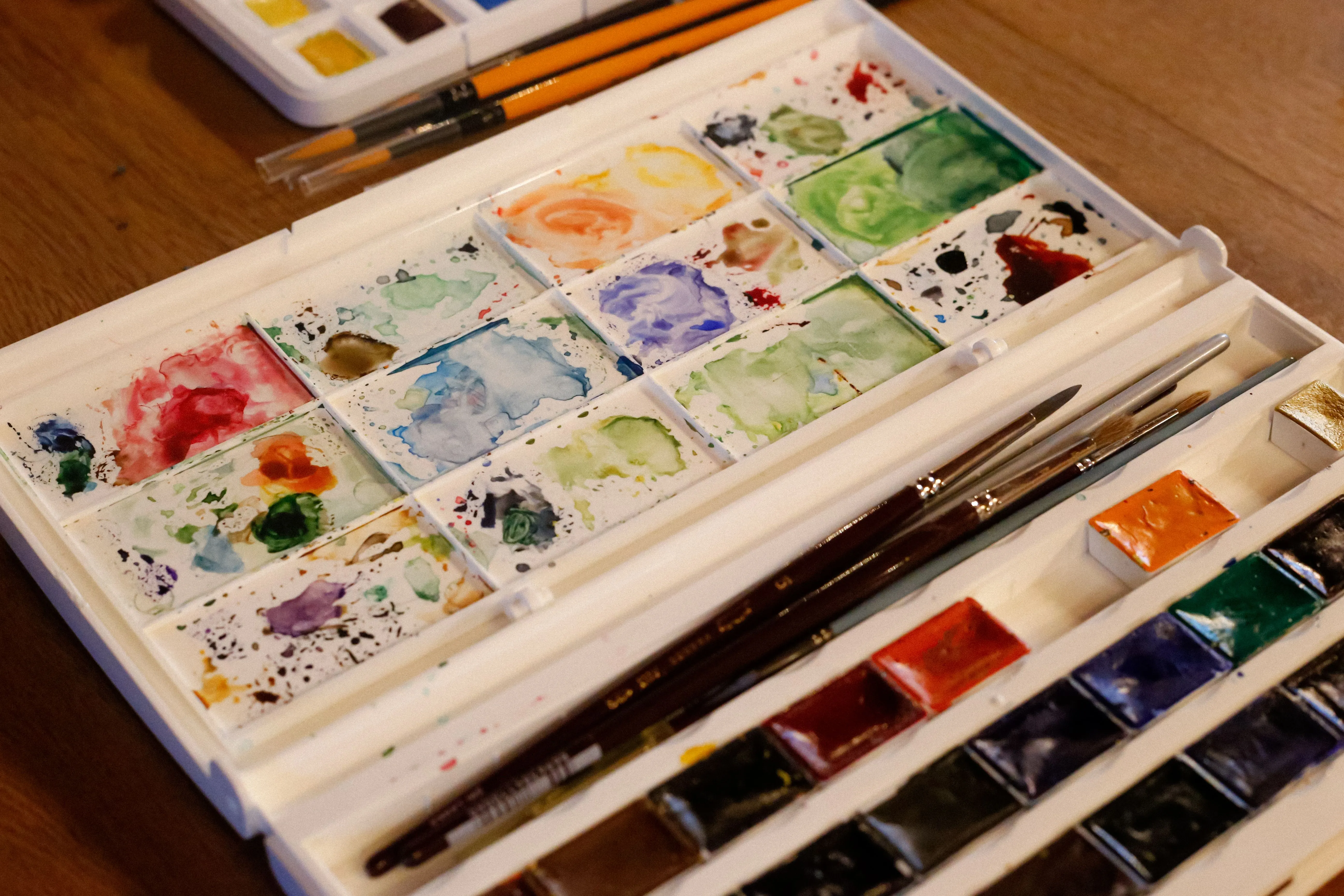
The first thing people notice about my palette is the mess. Half-dried pools of color, wells that have bled into one another, a rim stained by a hundred paintings I can't quite remember. I've stopped apologizing for it. That tray is a record of how I actually work — quickly, intuitively, and with a willingness to let things get away from me.
Watercolor rewards that willingness. Of every medium I've tried, it's the one that refuses to be fully controlled. You can plan a composition, mix the perfect wash, and lay it down with a steady hand — and the water will still do what water does. It pools where the paper dips. It dries lighter than you expect. It carries pigment into corners you didn't invite it to. For a long time I fought this. Now I treat it as a collaborator.
How I actually work
I almost always start wet. I'll flood an area with clean water and drop color in, watching it bloom and feather before I've decided what the painting is going to be. Those early, formless minutes are my favorite part — there's no precious image to protect yet, so I can be reckless. The painting tells me where it wants to go, and my job is mostly to listen, and then later to make decisions: where to sharpen an edge, where to let things stay soft, when to stop.
I work in layers, but thin ones. Watercolor's transparency means every layer is still in conversation with the ones beneath it; nothing is ever fully covered. In the Spring Glimmer pieces I push this further, dropping gold and silver leaf and ink into the washes so the light catches differently depending on where you stand. In the seascapes I keep it pared back — just pigment and water, because the medium already behaves like weather.
The practice around the painting
The painting itself is maybe half of it. The rest is looking. I spend a lot of time not making anything — watching how light moves across a wall in the afternoon, photographing skies, noticing the exact grey a horizon turns just before rain. By the time I sit down to paint, most of the real work is already done; I'm just trying to remember a feeling accurately.
I've also made peace with ruining things. Watercolor is unforgiving — you can't scrape back to white, you can't paint over a mistake the way you can in oil. So I make a lot of bad paintings on purpose, fast and low-stakes, to keep my hand loose and my expectations reasonable. The good ones tend to arrive when I've stopped trying to force them.
That's really the whole philosophy, if I have one: prepare carefully, then get out of the way. The water knows things I don't.